On my way from Wuhan city to Shanghai on bullet train, 15 June 2015, a mega inland fish farm, I only captured half of it.
Saturday, October 24, 2015


Friday, October 23, 2015
Aquaculture raceway system for growing shrimp and tilapia.
In July 2011, Dr. David Brune and some of his students at Missouri University’s Bradford Research Farm began building a greenhouse/raceway system for growing marine shrimp year-round in Missouri. Before joining the staff at Missouri University, Brune worked at Clemson University in South Carolina, where he developed a, partitioned aquaculture system for growing shrimp and tilapia. He has designed a similar system for central Missouri. It’s on one-fifteenth of an acre, and he thinks it will produce around 2,500 pounds of shrimp in the next six months. He wants to prove it’s possible to use sustainable technology to farm shrimp profitably in Missouri.


Friday, April 3, 2015
European Seabass - Dicentrarchus labrax

The European seabass (Dicentrarchus labrax), is a primarily marine fish that sometimes enters brackish water and found rarely in rivers for very short periods. It is also known as the sea dace. Highly regarded as a table fish, it is often marketed as Mediterranean seabass, loup de mer, robalo, lubina, spigola, branzino, branzini, bronzino, bronzini, Karouss قاروص in Egypt, and Braq براق in Lebanon.

European seabass were historically cultured in coastal lagoons and tidal reservoirs before the race to develop the mass-production of juveniles started in the late 1960's. Fish culture was initially associated with salt production in coastal evaporation pans and marshes. The salt was harvested during the high evaporation season of summer and autumn, and fish were cultured during winter and spring. The supply for this culture came from trapping schools of fish that lived in these estuarine areas.

During the late 1960's, France and Italy competed to develop reliable mass-production techniques for juvenile seabass and, by the late 1970s, these techniques were well enough developed in most Mediterranean countries to provide hundreds of thousands of larvae. The European seabass (Dicentrarchus labrax) was the first marine non-salmonid species to be commercially cultured in Europe and at present is the most important commercial fish widely cultured in Mediterranean areas. Greece, Turkey, Italy, Spain, Croatia and Egypt are the biggest producers.


Its habitats include estuaries, lagoons, coastal waters, and rivers. It is found in the waters in and around Europe, including the eastern Atlantic Ocean (from Norway to Senegal), the Mediterranean Sea, and the Black Sea.

Global production of seabass reached 162,172 tonnes in 2012, primarily from aquaculture (153,182 tonnes).

Sunday, November 3, 2013
One In Three Fish Sold At Restaurants And Grocery Stores Is Mislabeled

There are so many fish in the sea. But from a diner's viewpoint, peering down at a sliver of white fish atop a bed of sushi rice, a lot of them look the same. Now a report from the ocean conservation group Oceana confirms that there's a pretty decent chance that fish on the plate or on ice in the seafood case is not what it's labeled to be. That means that seafood wallet cards designed by conservation groups to help steer consumers towards sustainable choices may not be doing much good.

Between 2010 and 2012, Oceana took 1,215 seafood samples from 674 retail outlets in 21 states. When they tested the DNA, they found that 33 percent were mislabeled. Sushi vendors and grocery stores were the most likely outlets to sell mislabeled food, though Oceana says the fraud can happen before it reaches them. Earlier investigations by Oceana and the Boston Globe revealed that seafood mislabeling is common in cities like New York and Boston, where people eat a lot of fish. But the report out Thursday shows it's happening across the country, and is as bad or worse in places like Texas and Colorado. Some 49 percent of the retail outlets sampled in Austin and Houston sold mislabeled seafood, while 36 percent in Colorado did so.

So what's the big deal with fish sold under a pseudonym? Well, for one, it's often just a form of swindling – a cheap fish like tilapia sold as red snapper. But Oceana says the practice also can put consumers at health risk when species like king mackerel, which is high in mercury, or escolar, which contains a naturally occurring toxin than can cause gastrointestinal problems, are marketed as grouper and white tuna, respectively.Oceana's also concerned that substituting cheaper, easier-to-find fish for rarer, more valuable ones gives consumers a distorted sense of the market. Of the fish types most heavily sampled by Oceana, those sold as snapper and tuna had the highest mislabeling rates — 87 and 59 percent. Only seven of the 120 samples of red snapper purchased nationwide were actually red snapper, the report found. "The majority of fraud is various fish standing in for snapper – it's used as catch-all name for all kinds of white fleshed fish," says Oceana senior scientist Kimberly Warner. "But there are real conservation concerns when you slip in things in place of the real thing. People think snapper must be doing great because it's everywhere, but it's overfished."
Consumers using wallet cards from groups like the Monterey Bay Aquarium and NRDC could end up buying exactly the species they're trying to avoid, Warner says, because mislabeling is so prevalent.
One reason mislabeling has gotten so rampant is that the U.S. now imports 90 percent of its seafood and less than 2 percent is inspected for fraud. That means would-be fraudsters have a lot new options for substitutions.The Food and Drug Administration regularly updates its list of seafood approved for sale – in 2012 alone, 19 new species were added to the list, including cornetfish, sampa and claresse.

So what's the government or a consumer to do about all this? Oceana would like to see an international traceability system where retailers would be required to tell consumers where and when a fish was caught and what gear was used. Requirements like these would help the industry — one of the least transparent in the food system — more accountable.
 |
| Escolar, right, is often substituted for more expensive Albacore tuna (left), a report on mislabeled seafood found. Yoon S. Byun/Boston Globe via Getty Images
The National Fisheries Institute argues that the problem is one of enforcement — the FDA needs to do a better job of enforcing laws that are already on the books to discourage fraud. And they encourage consumers to seek out retailers through the Better Seafood Board.
|

Thursday, October 11, 2012
Lebanon Famous Marine Fish - Mormyrus

مرمور Marbré
Lithognathus
mormyrus

Size / Weight /
Age:
Max length:
55.0 cm TL male/unsexed; common length: 30.0 cm TL male/unsexed; max. reported
age: 12 years
Environment:
Demersal;
brackish; marine; depth range:
0 - 150 m, usually 10 - 20 m.
Climate /
Range:
Subtropical;
50°N - 40°S
Distribution:
Eastern
Atlantic: Bay of Biscay, Strait of Gibraltar and Mediterranean,
Black, and Azov seas to Cape of Good Hope, South Africa and the Mozambique
Channel. Also found around the Canary Islands, Cape Verde and Madeira Is.
Western Indian Ocean: Red Sea; southern Mozambique to the Cape of Good Hope;
not found in tropical east Africa.

Short
description:
Dorsal Spines (total):
11; Dorsal Soft
Rays (total): 12-13;
Anal Spines: 3;
Anal Soft Rays: 10 - 11
Found on the
shelf, over sandy and muddy bottoms as well as sea grass-beds and
estuaries.Gregarious, sometimes forming sizeable schools. Feeds on worms mollusks
and small crustaceans. Protandric hermaphrodite. Flesh excellent; sold fresh
and dried.
Threat to
humans: Harmless.
Human uses: Fisheries:
minor commercial; gamefish: yes.

Lebanon: مرمور, Marmour
Egypt: غزيلّة
Libya: منكوس
France: Marbré.
Italy: Mormora, Marmura, Marmarozza.

Sunday, March 11, 2012
List of Freshwater Fishes for Lebanon
| Acipenseriformes | Acipenseridae | Acipenser sturio | native | Sturgeon | |
| Anguilliformes | Anguillidae | Anguilla anguilla | native | European eel | H'anklyss |
| Cyprinodontiformes | Cyprinodontidae | Aphanius fasciatus | native | Samak Ghomoq | |
| Cyprinodontiformes | Cyprinodontidae | Aphanius mento | native | ||
| Atheriniformes | Atherinidae | Atherina boyeri | native | Big-scale sand smelt | Bizhreh 'Hâdy |
| Cypriniformes | Balitoridae | Barbatula panthera | native | ||
| Cypriniformes | Cyprinidae | Barbus longiceps | misidentification | ||
| Cypriniformes | Cyprinidae | Carasobarbus canis | misidentification | ||
| Mugiliformes | Mugilidae | Chelon labrosus | native | Thicklip grey mullet | Boûry Sayloun |
| Cypriniformes | Cyprinidae | Cyprinus carpio carpio | introduced | Common carp | |
| Cyprinodontiformes | Poeciliidae | Gambusia holbrooki | introduced | Eastern mosquitofish | |
| Cypriniformes | Cyprinidae | Garra rufa | native | ||
| Perciformes | Gobiidae | Gobius paganellus | native | Rock goby | |
| Cypriniformes | Cyprinidae | Hypophthalmichthys molitrix | introduced | Silver carp | |
| Mugiliformes | Mugilidae | Liza aurata | native | Golden grey mullet | Boûry Shylân |
| Mugiliformes | Mugilidae | Liza ramada | native | Thinlip grey mullet | Boûry Dhehbân |
| Mugiliformes | Mugilidae | Mugil cephalus | native | Flathead grey mullet | Gharyb |
| Cypriniformes | Balitoridae | Nemacheilus insignis | misidentification | ||
| Cypriniformes | Balitoridae | Nemacheilus leontinae | native | ||
| Salmoniformes | Salmonidae | Oncorhynchus mykiss | not established | Rainbow trout | |
| Cypriniformes | Balitoridae | Oxynoemacheilus angorae | native | Angora loach | |
| Cypriniformes | Balitoridae | Paracobitis tigris | native | ||
| Pleuronectiformes | Pleuronectidae | Platichthys flesus | native | European flounder | |
| Cypriniformes | Cyprinidae | Pseudophoxinus kervillei | native | ||
| Cypriniformes | Cyprinidae | Pseudophoxinus libani | native | ||
| Cypriniformes | Cyprinidae | Pseudophoxinus syriacus | native | ||
| Cypriniformes | Cyprinidae | Squalius lepidus | native | ||
| Perciformes | Cichlidae | Tilapia zillii | native | Redbelly tilapia |
Tuesday, March 6, 2012
Newly Discovered Catfish Potentially Fatal to Humans
LEBANON - Experts have warned that catfish which have recently begun migrating to Lebanese waters could be fatal to humans in certain circumstances.
TheDailyStar reports that recent diving operations carried out by divers from the Professional Divers Association in Lebanon and the Civil Defense Marine Rescue Team in the waters near the town of Jiyeh led to the discovery of a catfish sanctuary.
“Their presence in the seabed is beautiful and wonderful,” said diving instructor Maha Hajj, who headed the joint diving team.
Catfish, of which there are many various species, are so called due to the whiskers on their face, three on each side, according to the divers.
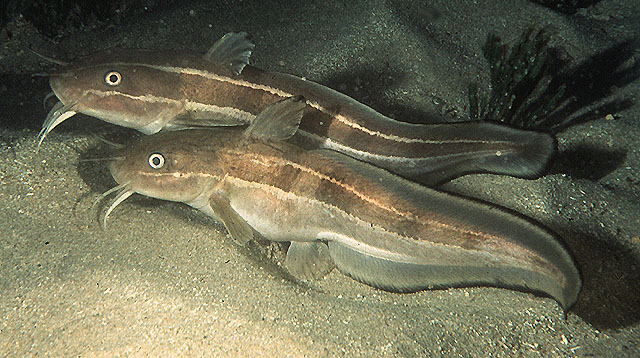
“The scene is amazing, catfish swim beside each other like a block of fire,” she told reporters. Ms Hajj said it was likely that this type of fish has come from the Red Sea, saying it was spotted for the first time in Tyre’s seabed over one year ago.
The divers, after carefully monitoring the movement of migrating fish, took photos of the seabed and filmed it with their cameras.
But Ms Hajj warned that the catfish could potentially prove fatal to fishermen. “The intruding fish are capable of stinging and have a harmful poison.”
“There are three thorns on the back and sides of the fish and once it stings, it emits a strong poison in the body of the human being, which might be fatal under some circumstances,” she added.
For his part, Mohammad Sarji, the head of the Professional Divers Association, said that the scientific name for this particular catfish is the Plotosus lineatus, from the Plotosidae family of the species.
“Their presence in the seabed is beautiful and wonderful,” said diving instructor Maha Hajj, who headed the joint diving team.
Catfish, of which there are many various species, are so called due to the whiskers on their face, three on each side, according to the divers.
“The scene is amazing, catfish swim beside each other like a block of fire,” she told reporters. Ms Hajj said it was likely that this type of fish has come from the Red Sea, saying it was spotted for the first time in Tyre’s seabed over one year ago.
The divers, after carefully monitoring the movement of migrating fish, took photos of the seabed and filmed it with their cameras.
But Ms Hajj warned that the catfish could potentially prove fatal to fishermen. “The intruding fish are capable of stinging and have a harmful poison.”
“There are three thorns on the back and sides of the fish and once it stings, it emits a strong poison in the body of the human being, which might be fatal under some circumstances,” she added.
For his part, Mohammad Sarji, the head of the Professional Divers Association, said that the scientific name for this particular catfish is the Plotosus lineatus, from the Plotosidae family of the species.
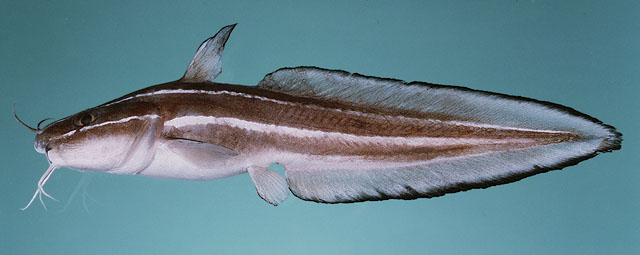
He explained that catfish cannot survive alone, but rather live in very large groups, with some numbering several hundreds.
This type of catfish seeks shelter in rocky caves, the experts said. Each fish can grow to up to 20 centimeters in length.
“The slogan for this particular fish is ‘examine but don’t touch,’” said Mohammad Mezher, the head of the Civil Defense Marine Rescue Team in the Jiyeh headquarters.
TheFishSite News Desk
Subscribe to:
Posts (Atom)